


.svg)
he Whorearchy is the social hierarchy that allows some sex workers to imagine themselves as inherently better or more respectable than sexworkers in other fields. Under the whorearchy, some are seen as classy or maybe even barely sex workers at all, while others get treated like embarrassing pity cases or worse. Stemming from the general whorephobia that saturates our world, it’s an awful ideology that harms just about everyone. Unfortunately, ending the whorearchy is easier said than done. Let’s answer some frequently asked questions about this hierarchy, unpack its origins, and brainstorm ways of combatting it.
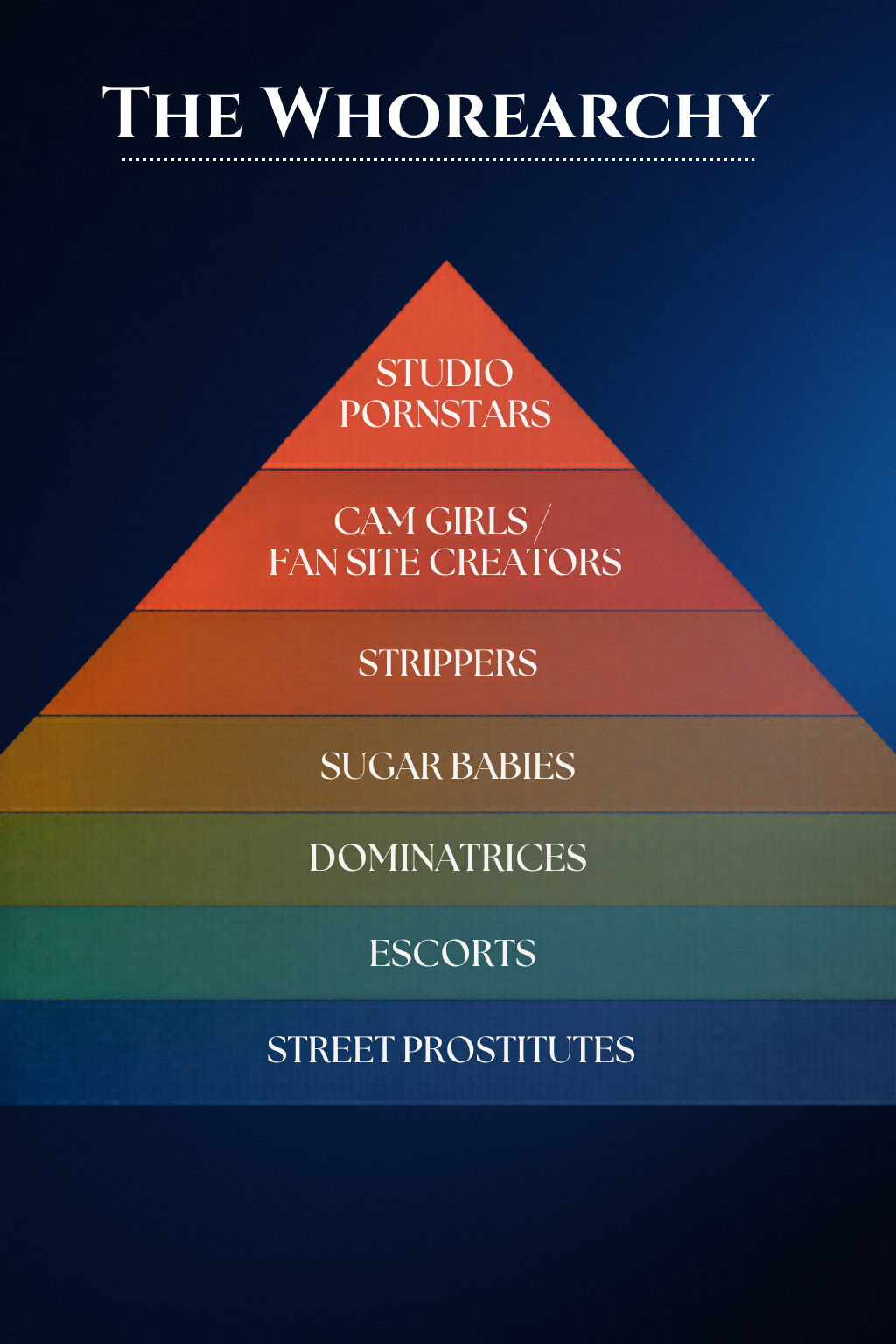
Anatomy of the Whorearchy: Who’s at the top?
There’s no true consensus as to who sits atop the whorearchy. Sometimes it’s “high class” escorts, sometimes it’s cam girls, sometimes it’s sugar babies, and on and on. As Belle Knox described for Jezebel, those ‘at the top’ are generally defined by having minimal contact with clients and police. Their work tends to be less criminalized and maybe even ‘not work at all.’ It often involves no penetrative sex (e.g. professional dominatrixes) or possibly no physical contact (e.g. phone sex operation).
Money is also extremely relevant – not just income but class. The more you charge the higher your perceived position may be. ‘High class escorts’ and sugar babies gain status by working with wealthy men and offering an experience that integrates ‘elite’ class indicators into their work. As escort Amy Taylor half-joked on Holly Randall Unfiltered “PSA, girls: if you want to make a lot of money as a companion, get good at golf.”
Who’s at the Bottom of the Whorearchy?
Full-service street sex workers are generally the most stigmatized, partially because of how visible and criminalized their work tends to be. Class comes into play, with lower rates adding to stigma. Police persecute street workers actively and often violently, making legal recourse from client abuse nearly impossible.
Street work is a dangerous job, and one that’s synonymous with “sex work” in the eyes of many. Because of that, other workers distance themselves from it, speaking about street workers as if they’re only a negative stereotype rather than a legitimate subsect of our community. Even well-meaning advocates can rest their arguments on the assertion that most of us aren’t working outside for small sums of money. Though that may be statistically true, it is not the reason we deserve rights, safety, and respect.
Beyond the work itself, factors about a worker’s identity can be seen as denoting lower status. Being impoverished, trans, Black, a drug user, and more can bump a worker down in other’s eyes. Not coincidentally, racially marginalized and queer sex workers are also more likely to face violence, criminalization and imprisonment. It adds insult to injury that seemingly the more difficult a sex worker’s life, the more likely they’ll be seen as “lesser” by others.
How is the Whorearchy Enforced?
Bullying is a major way the whorearchy is enforced. Strippers put down Belle Knox for “sitting on a dick for a living” after she started porn. At least other adult stars accepted her, right? Nope! They judged her for performing in rough sex scenes. The whorearchy can get awfully granular, and Belle is far from the only worker to have these experiences.
Beyond day-to-day interpersonal shittiness, sex workers also regularly find themselves excluded from jobs because of the breadth of their work. Holly Randall spoke with Kira Noir about how common it’s been for adult stars to refuse to perform with others because of their side work escorting: “it was like ‘well, I’m a pornstar but she’s a hooker.” The excuse might be fears around safety and, of course, no one should perform with someone they’re uncomfortable with…but all adult stars take the same tests. The stigma is a clear element.

Media Coverage Makes the Whorearchy Worse
Many folks higher in the whorearchy have direct power over their public image. Personal podcasts, TikTok accounts and YouTube channels give them space to tell their own stories and correct common misconceptions. Plus, many are white, materially comfortable, and able to easily project a vision of respectability in spite of how the world sees sex work. It’s a wonderful thing and has, in all likelihood, been a big part of shifting views on decriminalization.
Unfortunately, street workers generally don’t get the same power over their own narratives, especially if that’s the only form of sex work they do. This is for a few reasons, the most obvious being that street work is generally highly criminalized, so vlogging your time waiting for clients on a street corner isn’t the most appealing idea. The people who can safely document street work aren’t usually sex workers at all, so the media representation ends up dictated by outsiders whose vision is coated with infantilizing pity or unmasked disgust rather than a casual, humanizing curiosity.
Why Does the Whorearchy Exist?
The simple answer for why whorearchy exists is that it’s a coping mechanism for living as a sex worker in a world that’s saturated with whorephobia. I doubt that anyone in any profession has managed to escape the not-so-subtle messaging that paints sex workers as dirty, embarrassing, sickly and debased. How many of us were told in our teens we couldn’t leave the house looking like a “streetwalker”? I distinctly remember wearing fishnets to middle school and being asked pointedly by a sixth grader “Are you a whore?” It was evidently not a compliment. Whether you’re a sex worker or not, that messaging permeates into your worldview.
Sex workers can harbor immense whorephobia just as we suffer from that same stigma. Adhering to the whorearchy is a way of coping with that double-pronged attack. If we can find (or imagine) any sex workers that better fit stereotypes about our profession, we can use that to buffer ourselves from shame. ‘I’m not a dirty whore with no self respect, she is.’ It doesn’t stop the world from criminalizing, belittling, and discriminating against us, but, for those of us with access to it, it can act as a small comfort in an unfair world.
Internalized Whorephobia: We’re Not Alone
Whorearchy is a term specific to sex work, but it’s reflective of a near-universal experience of groups marginalized by broader society: internalized oppression. One of the cruelest aspects of stigma is how it seeps into its victims, convincing us to belittle ourselves and each other. Becoming disabled doesn’t cleanse you of ableism; realizing you’re gay doesn’t make your homophobia magically disappear; even living your whole life knowing your identity is marginalized doesn’t cure the skewed view imposed on you. There’s nothing about sex workers that makes us inherently more likely to reproduce harm that’s done to us.
We can learn how to combat the whorearchy not only from other sex workers, but many thinkers with varied backgrounds who’ve grappled with similar issues. I cannot recommend Dr. Devon Price’s book Unlearning Shame (2024) enough. It takes a broad view on how shame not only harms oneself but also others in shared groups. Plus, it gives many practical tips on, well, unlearning your shame. Natalie Wynn has created extensive, nuanced and often hilarious work on how internalized oppression manifests in the trans community (among others). These are just two example of countless internet personalities, writers, and academics outside of sex work who’ve discussed parallel experiences.
How Do We Fix The Whorearchy?
Unfortunately, we can’t just flip a switch and end the whorearchy even in ourselves let alone the world. Still, there are some practical steps we can take towards a more equitable future. Here are a few:
- Self-Reflection
Try introspecting about your relationship with sex work. What messages have you been taught about your work and the work of others? Try describing stereotypes of sex work. What feelings does that bring up? Dr. Price’s Unlearning Shame(2024) has some excellent worksheets/exercises to help out.
Noting Language/Behavior
Keep an eye out for moments where you or your peers might be accidentally buying into the whorearchy. Do you tend to emphasize the difference between your work and other sex work? Do you downplay your participation in the sex industry? Do you find yourself less likely to socialize with folks outside of your niche?
Releasing Shame
Do your best to treat yourself (and others) kindly if you notice these patterns. The whorearchy isn’t any individual’s fault and beating yourself up doesn’t do anyone any favors. If you can, focus on your desired outcome of positive change, not anxiety or blame about personal morality. We’re all just doing our best.
Pushing Back
Speak up when your peers express their internalized whorephobia. Do your best to catch yourself before expressing your bias. Encourage yourself and others to remember that ostracizing or shaming other sex workers doesn’t make any of us safer or more respected.
Learning More
Seek out the stories and perspectives of those in other fields of sex work you don’t have experience with. Remember that even perspectives initially off putting to you have something to offer. When possible, listen to voices unmediated by exploitative journalism or anti-sex work propagandizing.
Building Solidarity
Participate in community events, organizations, and activism that includes diverse sex workers. Channel the fear and shame that might contribute to the whorearchy into fighting for rights and respect for all of us. Maybe you’ll make some new friends!
Respect Differences
Remember that, despite our shared struggles, sex workers do have different experiences, needs, and priorities. There may be workers who’ve faced violence you’ve been insulated from, who have a much more challenging relationship with their work than you do, or who simply have more expertise in certain fields. Cultivate curiosity, empathy and openmindedness.
Wrapping Up the Whorearchy
To be honest, I still have a lot to learn on this subject. While my perspective draws on my life in other marginalized groups (and the excellent writing of Dr. Devon Price), my experience in sex work has only just begun. I’m no authority on interpersonal dynamics in the community and I have plenty of whorephobia to unpack in myself. So, I’ll give the final word to Kira Noir, whose career is wide-ranging and established. As she put it in her talk with Holly Randall, “A whore is a whore is a whore” and buying into the whorearchy “only hurts our community and helps people who want to hurt us.”